Although I may not have finished the novel the two voices that are apparent to me are those of a man and a woman. The narrator is interesting because she has all these different relationships with all sorts of women, that is reminds me of a man. Not saying that all men sleep around, because not all women sleep around. However, stereotypically men are the more sexually charged and permissive gender. One thing I found interesting is that the narrator does sleep around like a stereotypical man. The 2 voices of my blog will be between a stereotypical man and my personal reactions to the narrator.
I am a man. I love women. I love their scents, their tastes, and their bodies. I can have sex with a multitude of women and never truly have feelings for many of them. As the narrator left Jacqueline for Louise, I too understand being torn between two lovers. However, in the end it is about finding the greener grass. If I have to cheat on one to be with another, so be it. Like the narrator wanted to love Jacqueline as do I want to love someone. I’m not sure what it takes to love someone, but I assume I’ll know when I know.
I am a woman. I love men. I love their scents, their tastes and their bodies. I don’t understand the male species at all. Of course I believe sex can just be sex. I believe that people should experiment with different sexual partners just as the narrator has. I also loved her voice throughout the book. She was witty and aloof when it came to leaving lovers. I sometimes wish I had that ability. I would be lying if I said that women do not feel any kind of emotional connection after habitually having sex with someone. That is how I interpret the name. With every touch or person who we allow to experience our bodies leaves a mark. Whether it is on the inside or outside. We let them in and it is very difficult to erase the wording.
Tuesday, May 26, 2009
Sunday, May 10, 2009
The Rest is Still Unwritten (Skim)
I really liked the book Skim. I think one of the reasons I liked it is because there were no major climactic moments, the book was not trying to solve some major epidemic nor was it making a statement. It just, was. I also liked how this book was not necessarily dark but it showed the opposite of the “ideal” high school student. Skim wasn’t the captain of the cheerleading squad and she didn’t really have that many friends except Lisa.
I remember high school with bittersweet feelings. My freshman and sophomore year there wasn’t a day that went by that I didn’t feel ugly on some way. I never had the best clothes and acne was public enemy number one. Skim is a character that is in a transition stage. She’s not the prettiest or the thinnest girl in school but she is still trying to figure out where she fits in. Being a teenager is difficult enough, let alone Skim maybe a lesbian. A part that I am confused about is the relationship between Skim and Ms. Archer. Because in one scene they were kissing but Ms. Archer just kind of slips out of the picture and I wonder where their relationship stood in all this.
If there were no pictures I don’t think I would have understood the novel at well. One of the major things I thought the picture helped with was understanding Skim as a character. The graphics of her face added to the idea that she is in an awkward stage. Another thing I liked about the book are the colors. Although they were only black and white they reflected what was going on in the scene. In the scene where Skim is kissing Ms. Archer the picture is very white with lots of light. All the scenes where she’s walking alone are black. I think the author used this for symbolism. Being a teenager is hard; sometimes you feel I like you are the only person feeling empty and alone. However, there are times during that period where we start discovering who we are and what we like about ourselves. These periods make it easier to see the light at the end of the tunnel.
I have mixed feelings about the ending. I didn’t like it because I wanted to know what Skim’s future looked like. I wanted to know where her relationships went with the other characters, like Katie and Ms. Archer. I did like it though because it was her walking into the woods once again. Walking alone. I think it represents how we all keep walking along, no matter where we have been, we never really know where we are going. Life would be so much easier if we were characters in a book and the ending was already written. We would never have to fear what lies ahead, because we would already know how it ends.
I remember high school with bittersweet feelings. My freshman and sophomore year there wasn’t a day that went by that I didn’t feel ugly on some way. I never had the best clothes and acne was public enemy number one. Skim is a character that is in a transition stage. She’s not the prettiest or the thinnest girl in school but she is still trying to figure out where she fits in. Being a teenager is difficult enough, let alone Skim maybe a lesbian. A part that I am confused about is the relationship between Skim and Ms. Archer. Because in one scene they were kissing but Ms. Archer just kind of slips out of the picture and I wonder where their relationship stood in all this.
If there were no pictures I don’t think I would have understood the novel at well. One of the major things I thought the picture helped with was understanding Skim as a character. The graphics of her face added to the idea that she is in an awkward stage. Another thing I liked about the book are the colors. Although they were only black and white they reflected what was going on in the scene. In the scene where Skim is kissing Ms. Archer the picture is very white with lots of light. All the scenes where she’s walking alone are black. I think the author used this for symbolism. Being a teenager is hard; sometimes you feel I like you are the only person feeling empty and alone. However, there are times during that period where we start discovering who we are and what we like about ourselves. These periods make it easier to see the light at the end of the tunnel.
I have mixed feelings about the ending. I didn’t like it because I wanted to know what Skim’s future looked like. I wanted to know where her relationships went with the other characters, like Katie and Ms. Archer. I did like it though because it was her walking into the woods once again. Walking alone. I think it represents how we all keep walking along, no matter where we have been, we never really know where we are going. Life would be so much easier if we were characters in a book and the ending was already written. We would never have to fear what lies ahead, because we would already know how it ends.
Victoria Doesn't Really Have a Secret
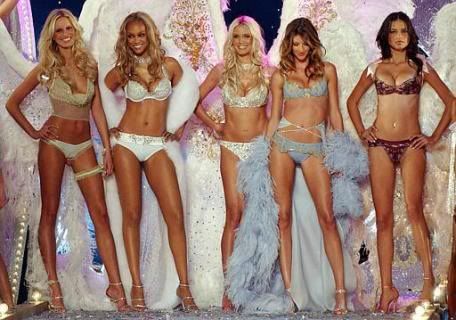
When I began to flesh out what women find sexy I found myself reflecting on my own personal desires and experiences. The beauty about being a woman is being able to crave a multitude of things. We have PMS: we lust for chocolate; we desire to be touched: we seek out sex. My picture is of Victoria’s Secret Angels. I chose this picture to personify my definition of desire because I view desire as an idea. Victoria’s Secret has built a million dollar empire based upon the idea of desire. Women desire to feel sexy in their own skin. Of course if their skin is covered in silky lingerie, it doesn’t hurt either. Although these models are incredibly beautiful I am not sexually attracted to them. However, I desire what they represent. They are the quintessential woman to a lot of men not to mention the envy of many average women.
I heard about this theory that women dress up for other women, not necessarily to attract men. I can’t say I completely agree with that idea but my example of desire proves it somewhat true. Models aren’t just attracting men with their sexy outfits, but they are appealing to a woman’s desire to attract men. So when a woman goes out wearing a great outfit and nice heels, although they may be looking for a mate, they may also subconsciously want other women to envy them.
So I guess in essence there is no secret to Victoria’s boudoir style lingerie line. The only secret held is that we are all sexual creature and we desire representations of sex. The angels relate to an ideal woman that most men will never have to chance to even meet. I guess my example relies on the idea that we always want what we don’t have: for men it’s sex with a supermodel, whereas for women it may be cellulite free thighs?
Sunday, May 3, 2009
Rose Colored Glasses
I have never read a graphic novel before. I never really got into comic books however; I think that the visuals helped the story progress in some cases. Conversations among characters were easier to understand. I also feel that during the action scenes it intensified the situation. I think if there were no pictures though, I wouldn’t be able to connect the scenes together. I was able to empathize with Carla, especially when she became fearful of her new Mexican friends.
Another thing I really thought helped the novel was the language. It was at times profane, yet honest. When the language was written in all caps for example I could tell the scene was about to intensify. I also liked how there was a translation section at the end of the book. It made me understand the storyline more and also how to identify with the characters. Understanding the language, helped me understand the story line.
When I think how Abel might define the word “woman” I think of the name of the novel: La Perdida. It means “lost” in Spanish. This is evident in the last page of the novel. Carla describes how she sees her past self, full of hope for the future and a fresh outlook on life. She sees her past self stumble down an alley and not soon after gets lost in the darkness. The last page Carla thinks “I wish I could find her again, that girl.” I identify with the idea of looking back and wanting to make amends with that girl I used to be. We get lost in the idea of change and are tempted by opportunity that we sometimes forget who our past selves are. Although my situations don’t involve getting held up in a Mexican drug cartel or almost going to prison, there are still things I would change. I think that is how Abel would describe a woman. Someone who looks at the world with rose colored glasses, gets lost a time or two, but emerges from the dark alleyways as a stronger person. Women may lose themselves but always come back to realizing who we truly are and where we came from
Another thing I really thought helped the novel was the language. It was at times profane, yet honest. When the language was written in all caps for example I could tell the scene was about to intensify. I also liked how there was a translation section at the end of the book. It made me understand the storyline more and also how to identify with the characters. Understanding the language, helped me understand the story line.
When I think how Abel might define the word “woman” I think of the name of the novel: La Perdida. It means “lost” in Spanish. This is evident in the last page of the novel. Carla describes how she sees her past self, full of hope for the future and a fresh outlook on life. She sees her past self stumble down an alley and not soon after gets lost in the darkness. The last page Carla thinks “I wish I could find her again, that girl.” I identify with the idea of looking back and wanting to make amends with that girl I used to be. We get lost in the idea of change and are tempted by opportunity that we sometimes forget who our past selves are. Although my situations don’t involve getting held up in a Mexican drug cartel or almost going to prison, there are still things I would change. I think that is how Abel would describe a woman. Someone who looks at the world with rose colored glasses, gets lost a time or two, but emerges from the dark alleyways as a stronger person. Women may lose themselves but always come back to realizing who we truly are and where we came from
Sunday, April 19, 2009
Looking for: The Peanut Butter to my Jelly
As I finished the book I came to a realization everyone is looking for the “water to their chocolate,” the “peanut butter to their jelly,” or as my friends know I would say: the “beer to my cigarette.” Tita says Pedro was the water to her chocolate when they got in a fight. She was on the verge of boiling over and going crazy which is what water literally does for chocolate. Love is such a crazy thing and there are all different ways to interpret it but when it comes to romantic love I am just searching for my “water.” I think sometimes we look for the “boiling point” in our counterpart. We want someone to drive us crazy and boil us over just so he or she can calm us down and bring us to a simmer.
Tita and Pedro had this star crossed love affair that had to be hidden from others for twenty years. At times in the book I found myself believing that Pedro was being such a dick and so selfish and I believed Tita could be stupid and childish. Although this book seemed like a mystical fairytale at times, it leads me to believe that things happen for a reason. I have always believed that there are times when the stars align and lead us to where we are supposed to be. For example in the book, characters had to die; others had to come into Tita’s life just to lead her to the union of her and Pedro. After all the trials and recipes they had to go through together they managed to keep their love burning.
One thing I found interesting is this sense of “boiling over” transcended to all relationships. Tita’s mother was an evil witch who kept Tita unhappy for so long. She made Tita’s blood boil until finally she escaped and lived with the doctor. Another example is the relationship of Pedro and Rosaura. It infuriated Tita but she stood by and watched them live a lie for a few years and even watched them build a family until one day she couldn’t take it anymore.
Something I found intriguing about the book was food being a critical character in the book. Tita put her heart and soul into her food and everyone around her seemed to pick up on that. She was devastated when she was baking a cake for Rosaura’s wedding. Whether it was bad eggs or her emotions, all the guests got violently ill from eating the cake. When Tita’s mother was left paralyzed she made her soup. Because the mother refused to eat it, she in essence killed herself from the lack of nutrition. It was one less thing standing in the way of her and the love she has always longed for.
Tita and Pedro had this star crossed love affair that had to be hidden from others for twenty years. At times in the book I found myself believing that Pedro was being such a dick and so selfish and I believed Tita could be stupid and childish. Although this book seemed like a mystical fairytale at times, it leads me to believe that things happen for a reason. I have always believed that there are times when the stars align and lead us to where we are supposed to be. For example in the book, characters had to die; others had to come into Tita’s life just to lead her to the union of her and Pedro. After all the trials and recipes they had to go through together they managed to keep their love burning.
One thing I found interesting is this sense of “boiling over” transcended to all relationships. Tita’s mother was an evil witch who kept Tita unhappy for so long. She made Tita’s blood boil until finally she escaped and lived with the doctor. Another example is the relationship of Pedro and Rosaura. It infuriated Tita but she stood by and watched them live a lie for a few years and even watched them build a family until one day she couldn’t take it anymore.
Something I found intriguing about the book was food being a critical character in the book. Tita put her heart and soul into her food and everyone around her seemed to pick up on that. She was devastated when she was baking a cake for Rosaura’s wedding. Whether it was bad eggs or her emotions, all the guests got violently ill from eating the cake. When Tita’s mother was left paralyzed she made her soup. Because the mother refused to eat it, she in essence killed herself from the lack of nutrition. It was one less thing standing in the way of her and the love she has always longed for.
Sunday, April 12, 2009
"Love" Lockdown
After reading the novel, "Love" it is apparent to me that Toni Morrison is not a woman of few words. Her writing although fluid, is decorated with lavish words. Her wording adds almost a "perfume-ity" to the story. This only leads me to believe that the narrator, "L" is an observer. She recognizes her surroundings and picks up on the types of relationships all these women have with Mr. Cosey. One of the relationships I find odd is that of Heed and Christine. Christine seems to have this inner hate and resentment for her step grandmother, yet remains in the same house at her. When Junior arrives I expected Heed to be this mean old woman when in fact she opens up her house to this runaway. I liked that Heed wasn't what I expected because it showed depth of character. Another thing I liked about the book was that it was not a typical love story. There were no white horses or candle light dinners. But the book displayed real love. The kind they don't show in movies or tv. The love these women received from this men wasn't perfect, at times it didn't even seem sensible to be in love with Cosey. I liked how the book showed love not only in a romantic way or how it is always displayed, but it was evident in every relationship. Between husband and wife, father and child, friend to friend.
The one thing I took from "Love" was the idea that it is not what you do in life but the mark you make on others while you're living. Death is a scary, lonely idea. I'm not sure what happens when you die. I'm not even sure I could concoct the perfect heaven or after life. I do know that life continues on without us. The only thing left of us is the "love" we shared with others and how they view us once we are gone. Although I didn't necessarily love "Love" I think Morrison did a great job of expressing the idea that we truly leave footprints in the hearts of others once we pass. The characters still held onto the feelings they had for Cosey when he was alive and whether it was negative or positive; it was love. Which everyone can attest to, is never perfect.
The one thing I took from "Love" was the idea that it is not what you do in life but the mark you make on others while you're living. Death is a scary, lonely idea. I'm not sure what happens when you die. I'm not even sure I could concoct the perfect heaven or after life. I do know that life continues on without us. The only thing left of us is the "love" we shared with others and how they view us once we are gone. Although I didn't necessarily love "Love" I think Morrison did a great job of expressing the idea that we truly leave footprints in the hearts of others once we pass. The characters still held onto the feelings they had for Cosey when he was alive and whether it was negative or positive; it was love. Which everyone can attest to, is never perfect.
Sunday, April 5, 2009
God is NOT a woman!
After reading “The Myth of the Vaginal Orgasm,” I have come to terms that our maker did not come with feminine parts. I believe Koedt was trying to disprove the vaginal orgasm and bring to light the woman’s role in sexual relationships. She referenced Freud when speaking of “frigid” women or women that could not achieve an orgasm during intercourse. I would like to say thank you Freud for comparing my vagina to an ice storm in Antarctica. A quote from the article that sticks in my mind is that ‘women are defined sexually by pleasing men.’ Women and men have been having sex for thousands of years and only recently has the importance of the female orgasm been appreciated. Sex is a partnership that should be important to both sexes. The article was written almost forty years ago and I do believe since then there has been a female sexual revolution.
This leads me to my own personal thesis statement: God is not a woman. The evidence has been staring women in the face for years. If the cold uncomfortable duck clamps at the gynecologist did not get the point across maybe it is the hundreds of dollars spent on tampons year after year or the joy of pushing a baby the size of a watermelon out of our vaginas. On top of all that we are faced with the reality that a vaginal orgasm may not exist. If that is not a “kick us when we’re down” moment, I do not know what is. When it comes to sex, men are like machines. You turn them on, they perform the task, and then you shut them off when you are done. Men are too easy because they know what they like. A woman does not exactly have to do circus tricks to turn him on. When it comes to women orgasms take time, they take concentrations, and sometimes they even take tequila. In that respect, I slightly agree with Freud when says frigid women need some sort of help in achieving an orgasm.
Whatever it is I feel roles have changed slightly in the past. Men have changed this idea of not only being confident because he has had sex with a woman but wanting assurance that he can get a woman to orgasm. I believe that since that article was written men have strived to be better lovers and women have become more sexually expressive. However, my theory definitely does not apply to all men and women!
This leads me to my own personal thesis statement: God is not a woman. The evidence has been staring women in the face for years. If the cold uncomfortable duck clamps at the gynecologist did not get the point across maybe it is the hundreds of dollars spent on tampons year after year or the joy of pushing a baby the size of a watermelon out of our vaginas. On top of all that we are faced with the reality that a vaginal orgasm may not exist. If that is not a “kick us when we’re down” moment, I do not know what is. When it comes to sex, men are like machines. You turn them on, they perform the task, and then you shut them off when you are done. Men are too easy because they know what they like. A woman does not exactly have to do circus tricks to turn him on. When it comes to women orgasms take time, they take concentrations, and sometimes they even take tequila. In that respect, I slightly agree with Freud when says frigid women need some sort of help in achieving an orgasm.
Whatever it is I feel roles have changed slightly in the past. Men have changed this idea of not only being confident because he has had sex with a woman but wanting assurance that he can get a woman to orgasm. I believe that since that article was written men have strived to be better lovers and women have become more sexually expressive. However, my theory definitely does not apply to all men and women!
Subscribe to:
Posts (Atom)

